
Current stage
TRL 3 engineering proof-of-concept progressing toward TRL 4.
Clinical Edge AI Prototype Programme
A privacy-preserving, human-governed clinical Edge AI programme progressing from engineering proof-of-concept toward integrated laboratory validation.
Clinical Edge AI prototype programme
Provenant AI Labs' flagship R&D programme for locally operated, human-governed clinical AI infrastructure progressing from TRL 3 engineering proof-of-concept toward an integrated TRL 4 laboratory prototype.
Public materials describe research and engineering scope. Any future configuration depends on validation, governance, procurement, site requirements and qualified stakeholder review.
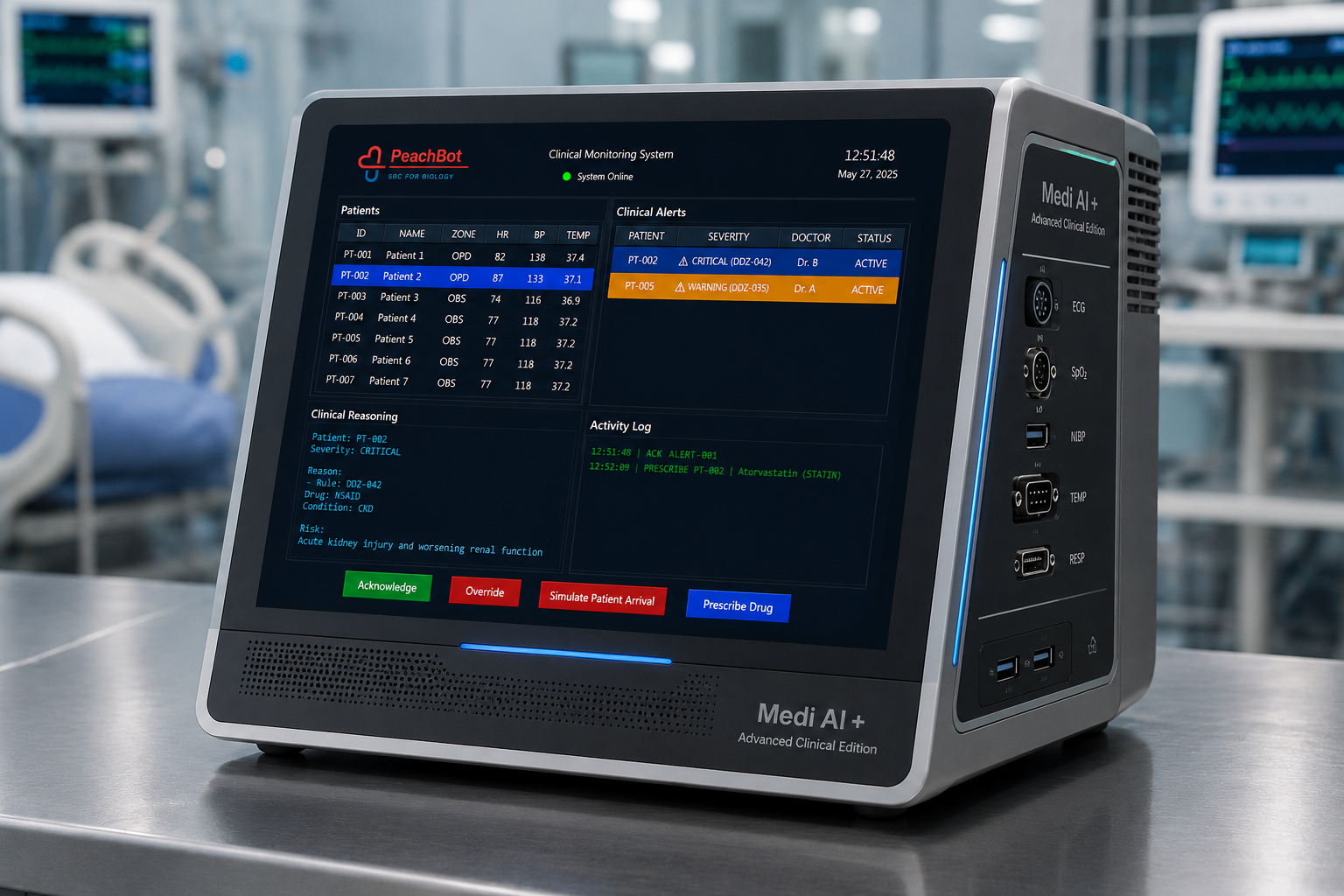
Product context
The visual represents the product or prototype concept associated with this route. The surrounding programme, workflow, hardware and governance requirements determine whether a future evaluation is appropriate.
Research stage
Medi AI+ is currently described as TRL 3 engineering proof-of-concept progressing toward TRL 4 integrated laboratory validation. It is not clinically approved, clinically validated or represented as a production hospital deployment.
TRL 3 engineering proof-of-concept progressing toward TRL 4.
Synthetic and controlled engineering inputs with human review.
Integrated laboratory prototype across software, edge hardware and peripherals.
System layers
Local speech processing with human-confirmed transcription and structured clinical context events.
Governed medical knowledge, retrieval, citations and refusal mechanisms from approved sources.
Structured context, observations, knowledge and deterministic safety rules for physician-reviewable information.
Designed for local or offline execution on target-class edge hardware; final performance validation is not claimed.
FHIR-oriented and integration-ready architecture under development.
Public capabilities
Hospitals, clinical research environments and healthcare institutions, subject to validation, regulatory assessment and institutional approval.
Engineering evidence
Engineering evidence does not constitute clinical validation, medical-device certification, regulatory approval or production hospital interoperability.
Read engineering statusQualified enquiry
This page is for research, pilot and qualified programme discussions. It is not a claim of clinical approval or general commercial availability.
Pilot & Regulatory Notice
Medi AI+ is currently a pre-clinical engineering programme. Product concepts and pilot configurations shown on this website are for stakeholder evaluation, controlled pilot planning, and qualified commercial discussion only. They are not represented as HSA-registered or approved medical devices, diagnostic systems, treatment systems, autonomous clinical decision-making, or substitutes for professional clinical judgement. It is not approved for diagnosis, treatment, or unsupervised clinical use. Any Singapore deployment must undergo appropriate institutional review, clinical governance, cybersecurity assessment, procurement checks, PDPA/data protection review, and, where applicable, Health Sciences Authority (HSA) medical-device classification, registration, licensing, and approval processes before clinical or operational use.